Animation project at Cantagallo

February 17th, 2010

About halfway through there’s some great stop-motion work done by the kids at Cantagallo.

DIY Lego Liquid-handling robot for gene synthesis

February 16th, 2010

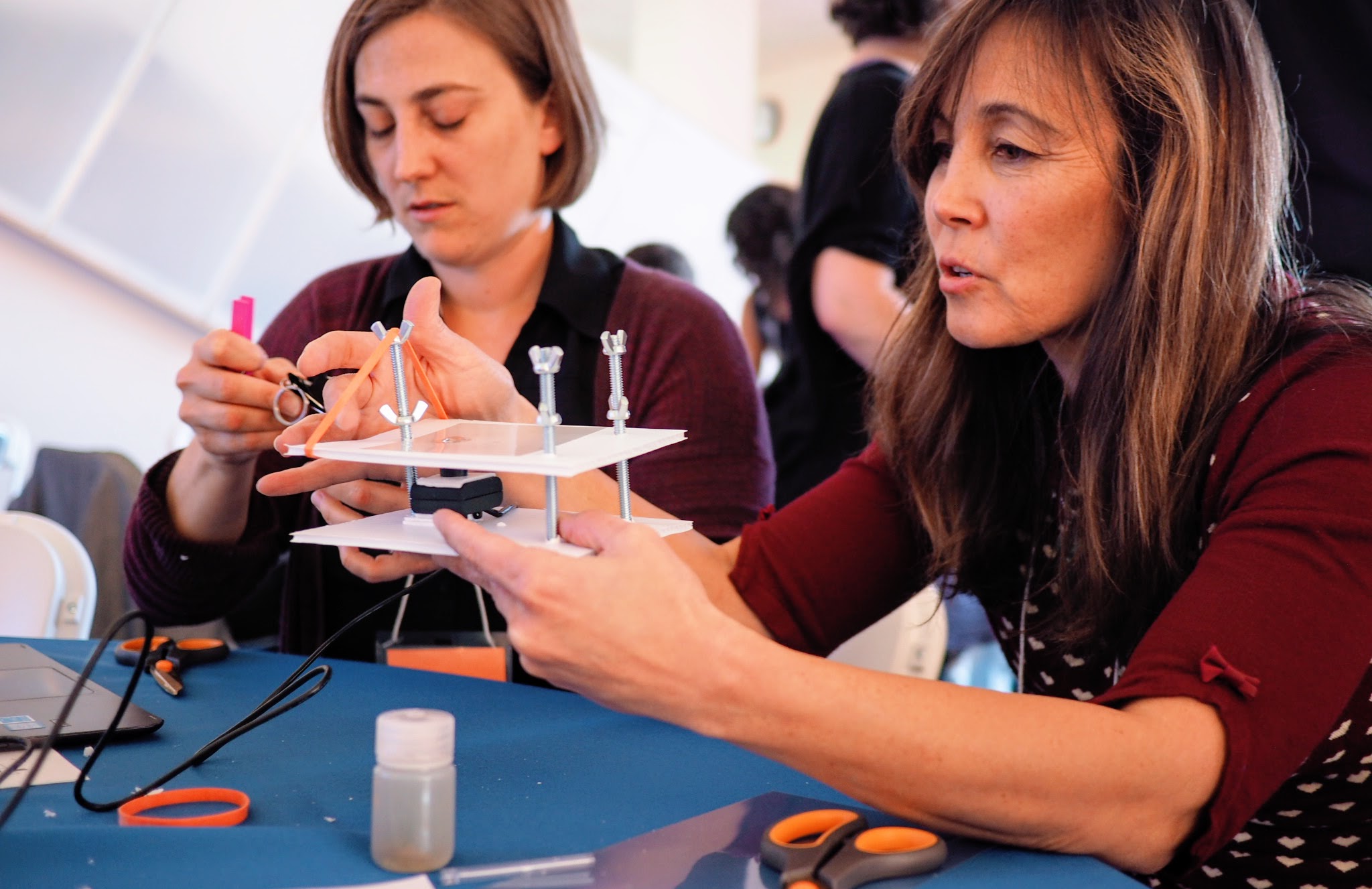
A University of Washington-based IGEM 2009 team (see project page) has created a Lego-based robot to assist gene synthesis researchers – for only $700 in parts, as opposed to the over $100k price tag of a commercial liquid handling robot (see for example Tecan’s Freedom EVO product).

This reminds me strongly of Jonathan Ward’s MTM A-Z personal fabrication machine, developed at the Center for Bits and Atoms at MIT. I bet Jonathan & co. could make a cheaper and more powerful machine for less… they should collaborate!

Read about a hard-working team which competed in iGEM’s 2009 event without access to a robot in a recent New York Times Magazine article.

Daniel Miracle and hyperlocal DIY TV station in Cantagallo

February 12th, 2010

Daniel Miracle is in the midst of a month-long project with Lima-based art/technology/culture program Escuelab, where he has been collaborating with a group of arts-oriented members of the Cantagallo community on a range of projects. Most excitingly, he’s been setting up a hyperlocal TV station with a range of only a few hundred meters — and helping kids from Cantagallo broadcast live TV programs on channel 39. (Some programs are taped and are available on the group’s web site) The entire transmitting setup (parts of which you can see in the picture below) cost around $200. I was amazed to see kids interviewing each other on live TV in the Shipibo language — asking questions like ‘why did we move to Lima’ and so forth.

The Shipibo arts group is called Shuawa after the ’satellite bird’ from Shipibo legend; the shuawa bird acts as a network to relay messages among Shipibo maestros. With Daniel’s support, Shuawa has also been running arts workshops for kids, including video and hand-drawn animation. As part of their workshops, Carla del Carpio and I were lucky enough to be able to do some Grassroots Mapping sessions there. (The coincidence of the meaning of Shuawa and the “people’s satellite” we built as part of our balloon mapping work there was great!)

This project was super inspiring to me — above all because among media technologies, I think of television as the least participatory, and as one which is typically used to support centralized power structures. While Daniel isn’t the first to use short-range television broadcasting as a community-run cultural medium, it’s nevertheless a very exciting inversion of an ‘old’ technology.

GrassrootsMapping featured in ?Digital Cartography? video

February 1st, 2010

Andrew Ellis and Alexander Wang of the Dynamic Media Institute at Massachusetts College of Art and Design created this short video which has some great footage of balloon flights and some bits of me talking about Grassroots Mapping.

Digital Cartography from dynamicmediainstitute.org on Vimeo.

Tidying up Cartagen a bit with tips from dev.opera.com

January 31st, 2010

dev.opera.com has a great series of tips for improving JavaScript performance. Example:

Use strings accumulator-style

String concatenation can be an expensive process. Using the “+” operator does not wait for the result to be assigned to a variable. Instead, it creates a new string in memory, assigns its result to that string, and it is that new string that may be assigned to a variable. The following code shows a common assignment of a concatenated string:

“a += ‘x’ + ‘y’;”

That code would be evaluated by firstly creating a temporary string in memory, assigning the concatenated value of ‘xy’, then concatenating that with the current value of “a”, and finally assigning the resulting value of that to “a”. The following code uses two separate commands, but because it assigns directly to “a” each time, the temporary string is not used. The resulting code is around 20% faster in many current browsers, and potentially requires less memory, as it does not need to temporarily store the concatenated string:

a += ‘x’;
a += ‘y’;

Completed, printed map of Juan Pablo II!

January 30th, 2010

Late Wednesday I finally finished the first draft rectification of the kite/balloon images from Juan Pablo II and also of Cantagallo; I took a cab out to Surco to where they have plotters and ran off a couple big maps for each community. On Thursday, Carla, Nancy, and the CEDRO teachers stayed out the whole day in Villa el Salvador because there was a parent teacher meeting at 6pm. In the meantime we got out the big map and all the kids found their homes (just like in Google Maps, right?) and outlined them on trace paper.

The best part of the day was meeting the parents and showing them all the great work the kids had done on both the history “project” and the “future” project. The model of the community in 7 years (as mentioned in a previous post) was especially exciting. See all pictures of the history/future projects on Flickr.

And finally, we presented the completed map of Juan Pablo II to the parents as well. Since the kids had outlined homes and such, we were able to show the president of the community (several of the leaders came) a completed map with annotations. He seemed pretty excited and we’re meeting up with him on Tuesday to talk more about it, and possibly stitch the map we’ve made onto an overall community plan they already have. This should help them fill in detail like homes and streets.

The meeting was at night, so we had a free afternoon, giving Cesar, Jesus, Jian, and a bunch of other kids the chance to build a really huge kite from bamboo and trash bags.

The kites didn’t all fly (Cesar’s did!) but we learned a bit about what makes a good kite. Next time we’ll try for a really huge one that is still stable.

History & Future of Juan Pablo II

January 27th, 2010

The CEDRO teachers and I were inspired by Jay Silver’s work with Awareness Mapping (watch his presentation here) and so we’ve been doing some paper mapping exercises, though focusing more on history and buildings and such. The ‘history of the community’ project (view on Flickr) went so well that we assigned a ‘future of the community’ assignment and asked kids to bring in maps or drawings of the community in 5-10 years. They came back with some great stuff (see the project on Flickr), and two students went nuts and made a whole scale model of the neighborhood (7 years from now) in 3D!

Notice the great attention to detail in multiple story homes. There’s a pharmacy, hair salon, etc. I’ll be uploading more photos of this assignment soon, including a panorama of the model town!

Good and bad news from Bethlehem

January 25th, 2010

Here are some quick updates from Alice Gray at Bustan Qaraaqa. First, news of Abed’s farm at Um Salamoneh (I’d written about it earlier under the name Umm Salamuna where we did kite mapping):

We also organized tree-planting days at Bustan Qaraaqa, at Abed’s farm in Al Wallaja and in Um Salamoneh, on land threatened with confiscation to make way for an Israeli cemetery. Abed’s situation has improved quite significantly since our last newsletter, as his lawyer has managed to secure him a blue Jerusalem ID. This means that he is now legally entitled to be present on his land, although there is still a serious threat from Israeli real-estate developers, who continue to push for his expulsion to make way for settlement expansion. This season we were able to raise enough money to install a rainwater harvesting system at Abed’s, donating 2 water tanks (thanks Imo!), and are still working on a project to create a greenhouse outside the cave.

(Above, a photo of Abed and Jared)

Unfortunate news, however, about friends Jared and Faith, who were such good hosts when Josh and I visited:

The latest move in what seems to be a sinister trend aimed at silencing dissent and removing ‘witnesses’ to Israel’s occupation of the Palestinian Territories, has been the denial of entry to international NGO workers and journalists based in the West Bank. Many such people had been out of the country over Christmas and were refused entry at Ben Gurion airport when they attempted to return to their homes and jobs. Among the ‘casualties’ of this policy were our dear friends Jared Malsin (chief editor of the Maan News English Desk) and Faith Rowold (Public Relations officer of Dar Annadwa) who had been on holiday in Prague. Faith was immediately deported to Prague, whereas Jared spent a week in detention attempting to contest his case on grounds of ‘freedom of the press’ before he too was put on a plane and flown out (read story here).

Jared and Faith, like many internationals, were living and working in the Palestinian Territories on Israeli tourist visas, being unable to obtain work permits from Israeli authorities. They were deported for ‘refusing to cooperate’ during their interrogation at Ben Gurion airport; yet they were placed in this position by Israeli authorities themselves who would not give them the necessary visas to pursue their legitimate work and have a long history of refusing entry to people admitting to connections with Palestinian organisations or individuals. Recently, Israel has stopped issuing work permits to all West Bank based NGOs including Oxfam, Save the Children, Doctors Without Borders and Handicap International, forcing all foreign employees to rely on tourist visas (see story here) and placing them in a very precarious position.

That sucks. You can also read about it at the Washington Post. Good luck, Jared and Faith!

Fixing Cache Images plugin in Wordpress on MediaTemple

January 24th, 2010

Matt Mullenweg’s great Cache Images plugin for WordPress (Just go to the Plugins > Add New page in your WordPress install and search for it) lets you copy any hotlinked images on your blog into your own /uploads/ folder for safekeeping (and to be polite to others’ servers!), and I love it. But when you first install it, it often chokes, especially on MediaTemple. I’ve had problems with this more than once, so I thought I’d jot this down for future reference and to help anyone else struggling with the same issues. The two problems are a) permissions for the /uploads/ folder, and b) the file_get_contents() function. Here’s a fix:

First, you have to change the uploads directory from a long absolute path to just a relative one, so in Settings > Miscellaneous, instead of:

/bla/bla/mediatemples/long/url/domainname/html/wp-content/uploads/

it should say:

wp-content/uploads

Second, you have to change the file_get_contents() call on line 118 of the plugin file “plugins/cache-images/cache-images.php”. MediaTemple and other hosts don’t like that. But you can usually use the curl() library, so if you add the following code somewhere near the top of the file, you can use this fancy new ‘file_get_contents_curl()‘ function instead of the native one:

function file_get_contents_curl($url) {
	$ch = curl_init();

	curl_setopt($ch, CURLOPT_HEADER, 0);
	curl_setopt($ch, CURLOPT_RETURNTRANSFER, 1); //Set curl to return the data instead of printing it to the browser.
	curl_setopt($ch, CURLOPT_URL, $url);

	$data = curl_exec($ch);
	curl_close($ch);

	return $data;
}

Then all you have to do is change the call (on what USED TO BE line 118) to:

$img      = file_get_contents_curl( $b['scheme'] . '://' . $b['host'] . str_replace(' ', '%20', $b['path']) . $b['query'] );

That is, just change “file_get_contents” to “file_get_contents_curl()”.

I’d do it myself for you and host the file, but it’s not my code. Hmm, can I commit this change anywhere? Matt?

OurGoods Trade School – teach and learn in NYC

January 23rd, 2010

Caroline of OurGoods.org has organized a “Trade School” where you can come to learn or teach among peers!

Take a class every night with a range of specialized teachers in exchange for basic items and services. Secure a spot in a Trade School class by meeting one of the teacher’s barter needs.

Come to Trade School for thirty days of classes, co-working and bartering at GrandOpening’s Lower East Side storefront from January 25 to February 28, 2010.